Godoy's Wolves LLCGODOY'S WOLVES
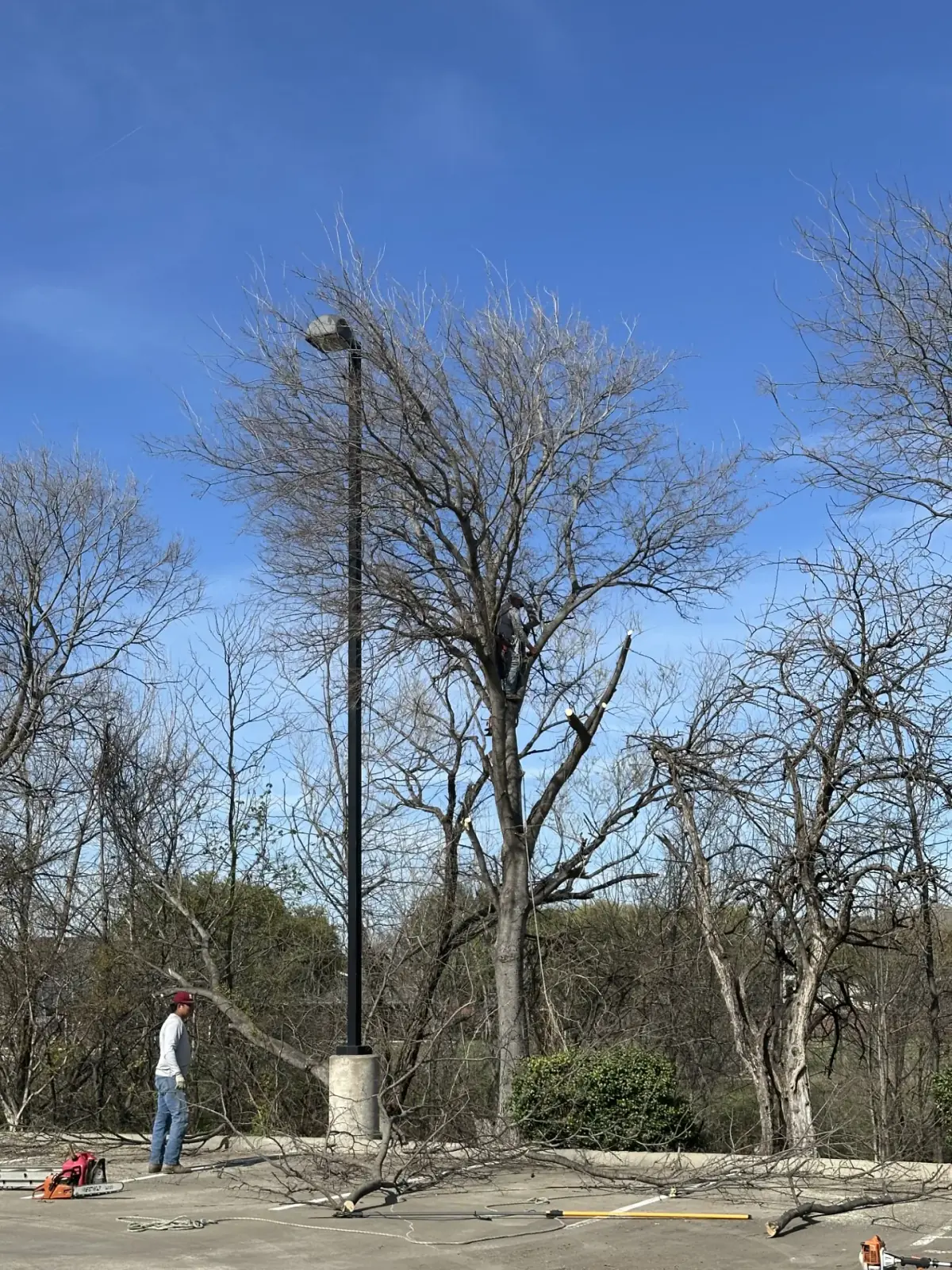
Climber roped into a tree with fresh pruning cuts visible, ground crew and chainsaws staged below

Tree Trimming & Pruning · Dallas–Fort Worth

Tree Trimming Done to Standard

Tree trimming is the removal of selected branches to improve a tree's structure, health, and clearance. Done properly it means cuts at the branch collar, no more than about a quarter of the live canopy in one season, and never topping. Godoy's Wolves trims across DFW, licensed and insured, with free on-site estimates.

Licensed & InsuredISA-Standard CutsFree EstimatesWe Never Top a Tree

Get a Free Quote

Tell us about the property and Rafael will get back to you fast.

No obligation · Fast response · Licensed & Insured · or call (469) 301-6801

Privacy PolicyTerms of Service

Most Trimming Around Here Is Actually Topping

Topping is cutting a tree back to stubs, and it is the most common thing done to trees in North Texas. It is fast, it looks decisive, and it is the single worst thing you can do to a healthy tree. A topped tree responds by throwing dozens of weak shoots from below each cut. Those shoots are attached to the outside of the wound rather than anchored in the trunk, they grow fast, and in five to ten years they break in exactly the storms you were trying to protect the house from.

Proper pruning removes whole branches back to a union, at the collar, so the tree can seal the wound. The canopy stays roughly the shape it grew into. The tree is smaller or thinner or lifted, but it is still a tree rather than a pole with a broom on top.

If a tree genuinely needs to be much smaller than it is, the honest answer is usually that it was planted in the wrong place and should be replaced, not topped. We will tell you that instead of selling you the same job every three years.

The Cuts That Actually Have Names

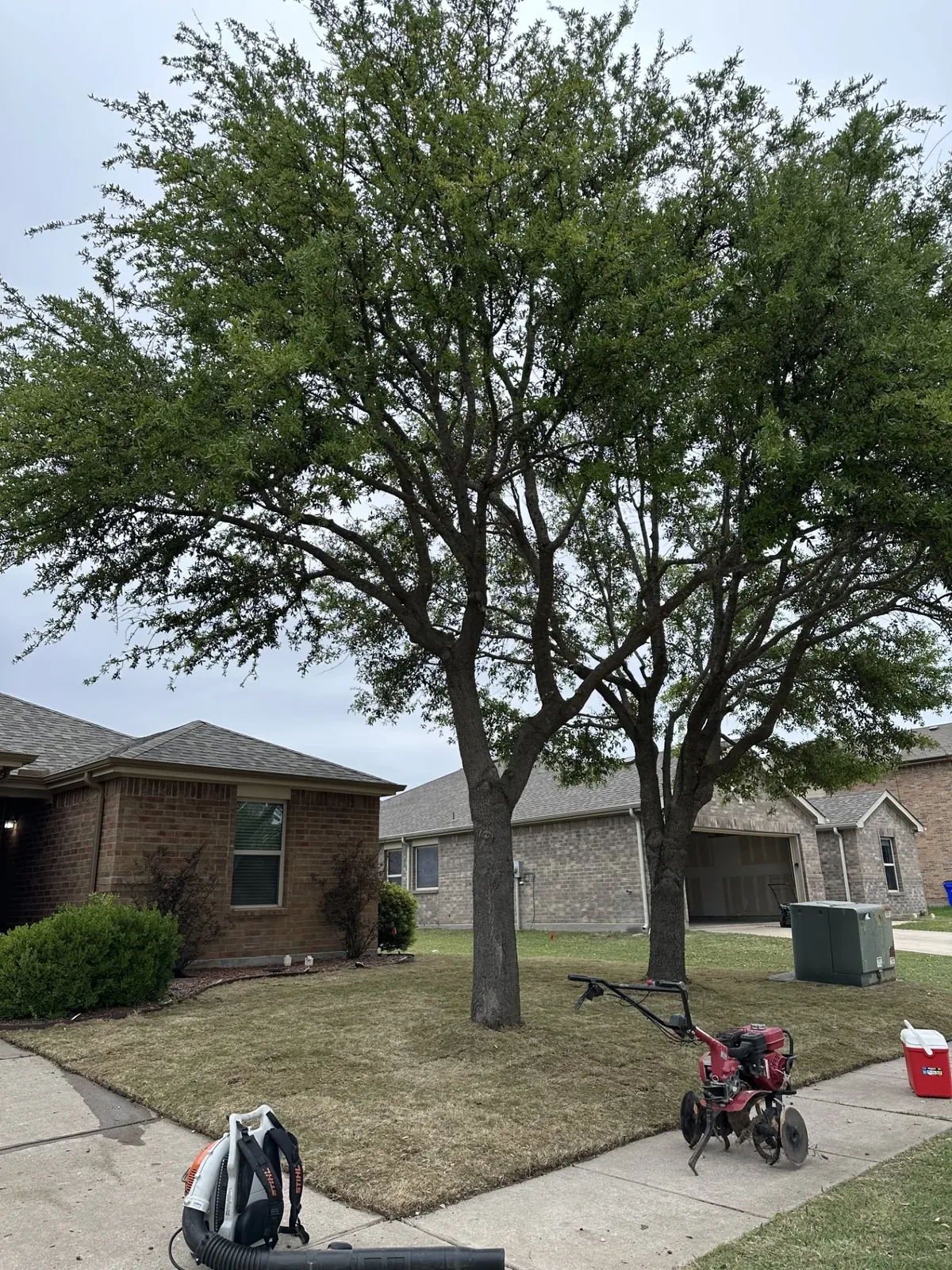
Two mature cedar elms with dense interior canopy on a North Texas front yard

Crown Thinning

Selective removal of interior branches to let wind and light through the canopy without changing its shape or size. This is what people usually mean when they say a tree needs to be 'opened up' before storm season.

  • Reduces wind sail and limb failure
  • More light to the lawn beneath
  • Shape and height unchanged
  • Never more than about a quarter at once
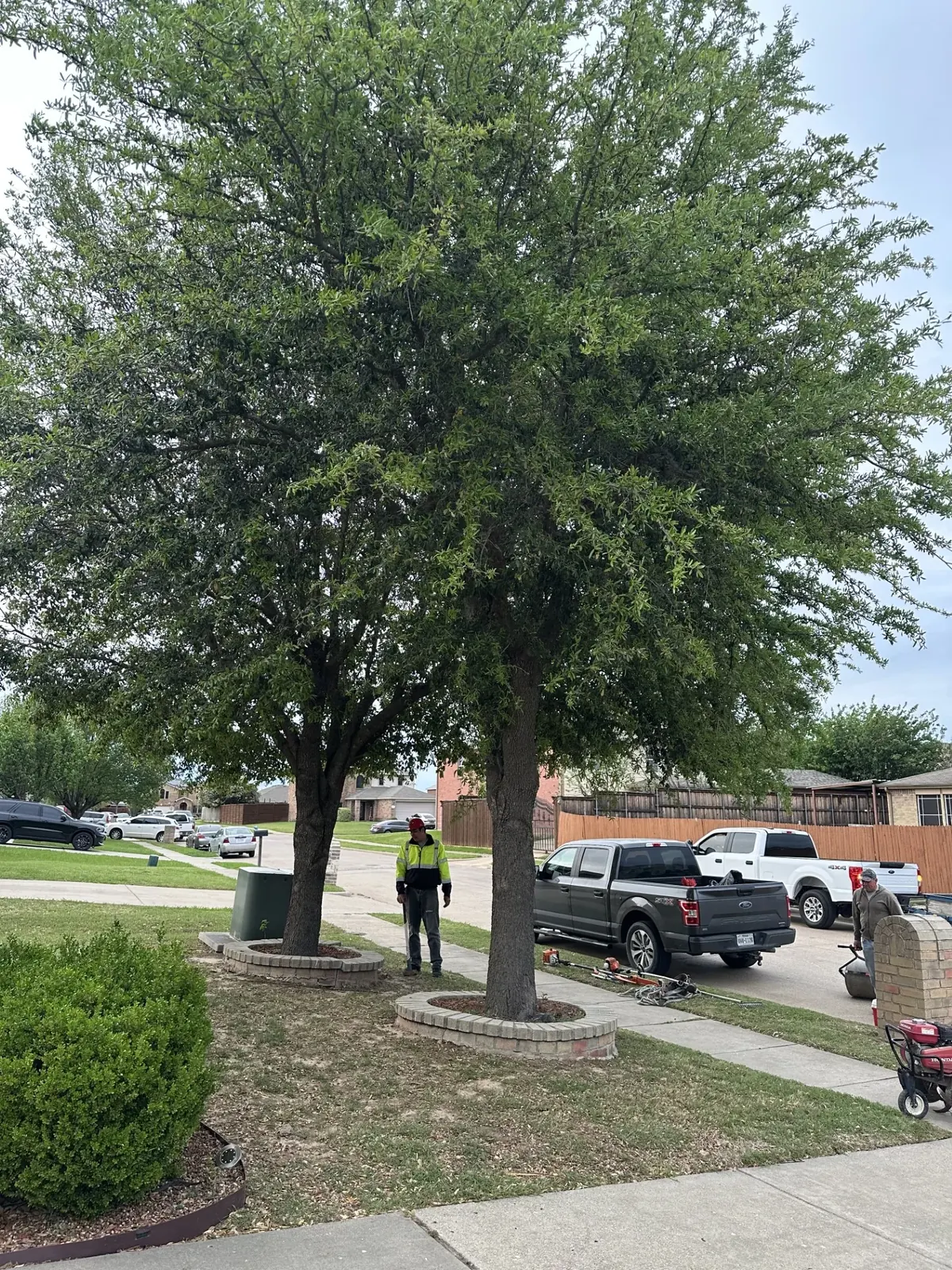
Uniformed crew member and work trucks beside cedar elms with the canopy lifted clear of the walk

Crown Lifting

Removing the lowest limbs to clear a roof, a drive, a walk, or the mower. The most requested job we do, and the easiest one to overdo. Lifting too high leaves a tree top-heavy and stressed.

  • Roof, gutter, and chimney clearance
  • Drive and sidewalk clearance
  • Line-of-sight for signs and cameras
  • Mower and equipment clearance

Crown Reduction

Shortening limbs back to a lateral branch big enough to take over as the new leader. Real reduction is slow and selective. It is what should happen when a tree is genuinely too large, and it is what topping pretends to be.

  • Cut back to a viable lateral
  • Natural form preserved
  • Weight taken off long limbs
  • Staged over seasons on big trees

Deadwooding

Taking out the dead, dying, and broken limbs and the hangers left behind by a storm. This is the highest-value trimming there is, because deadwood is what actually falls on people and cars.

  • Dead and dying limb removal
  • Storm hangers taken down
  • Torn stubs cut back clean
  • No live growth removed

Structural & Formative Pruning

Correcting competing leaders and weak forks on young and middle-aged trees. The cheapest tree work you will ever buy and the least often requested, because the problem it prevents is fifteen years away.

  • Single dominant leader established
  • Narrow forks corrected early
  • Included bark addressed
  • Prevents the removal you would pay for later

Crape Myrtles & Hedges

Crape myrtles get pruned, not decapitated. The annual stub-cutting done across North Texas produces knuckles, weak whippy growth, and flowers that flop over in the first rain. Hedges and shrubs shaped rather than sheared flat.

  • Crape myrtles thinned, not topped
  • Suckers and crossing limbs removed
  • Hedge and shrub shaping
  • Seasonal maintenance programs

Tree Trimming Across Dallas–Fort Worth

Every city we serve, with local crews rather than a dispatch from three counties away.

DallasPlanoFort WorthFriscoMcKinneyAllenRichardsonGarlandProsperCelinaHighland ParkUniversity ParkSherman

Common Questions

How much does tree trimming cost?

It is priced per tree after Rafael sees it, because a crape myrtle and a sixty-foot pecan over a roof are not the same job and no price list covers both honestly. What moves the number is size, access, how much has to come out, and whether anything below has to be protected. The estimate is free and on site, and you get a firm number before anything starts.

When is the best time to trim trees in Texas?

For most species, late winter while the tree is dormant. The structure is visible with the leaves off, cuts seal fast when growth resumes, and insects that spread disease are not active. The big exception is oaks, which should not be pruned February through June because of oak wilt. Dead and hazardous limbs come out whenever you find them, in any season.

Why should oaks not be trimmed between February and June?

Oak wilt is a fungal disease active across North Texas, and it spreads two ways: underground through root grafts between neighboring oaks, and above ground by sap beetles that are drawn to fresh pruning wounds. Those beetles are most active February through June, so a fresh cut in that window is an open invitation. We schedule oak work outside it, and when a hazard genuinely cannot wait we cut and immediately seal the wound.

What is topping, and why do you refuse to do it?

Topping is cutting a tree back to stubs rather than to a branch union. The tree responds by pushing dozens of fast, weak shoots from below each cut, attached only to the outer wood rather than anchored in the trunk. Within five to ten years those shoots are big enough to break, which means a topped tree is more dangerous than the one you started with, not less. It also leaves wounds too large for the tree to seal, so decay works into the trunk. We will reduce a tree properly or tell you it is in the wrong place, but we will not top it.

How much can be taken off a tree at once?

About a quarter of the live canopy in a season is a sensible ceiling on a healthy mature tree, and less on one that is old, stressed, or recently damaged. Leaves are how a tree feeds itself, so removing too much at once starves it and triggers a flush of weak growth. If a tree needs more than that, it should be staged across two or three seasons.

How often do trees need trimming?

Mature shade trees usually every three to five years. Young trees benefit from a light structural prune every two to three years while their form is still being decided. Anything overhanging a roof or a drive gets looked at more often, because clearance closes up faster than you think. A tree that needs work every single year is usually being topped rather than pruned.

Will trimming hurt my tree?

Every cut is a wound, so the question is whether the benefit is worth it. Removing deadwood, clearing a roof, and correcting a weak fork are worth it. Thinning a healthy canopy because it looks thick is usually not. We would rather take less and come back than take too much once, and we will tell you when the answer is to leave a tree alone.

Do you clean up and haul off the limbs?

Yes, always, and it is included. Limbs and chips leave with us, the ground is raked, and hard surfaces are blown clean before we go. If you want the wood cut to firewood length and stacked instead, say so and we will do that.

Do you handle HOA compliance trimming?

Yes, across DFW's managed communities. We meet the deadline in the notice and leave documentation your HOA will accept, so the letter stops.

Do you trim trees near power lines?

Work near a service drop gets coordinated with the utility rather than worked around. We will also tell you plainly when a limb is the power company's responsibility, so you are not paying us for something they will do at no cost.

Have Someone Look Before You Cut

Free on-site estimate, a firm price, and an honest answer about whether your tree needs the work at all.

📞 Call (469) 301-6801Free Quote →